#WeAreSwitzerland
Browse topics

Browse topics
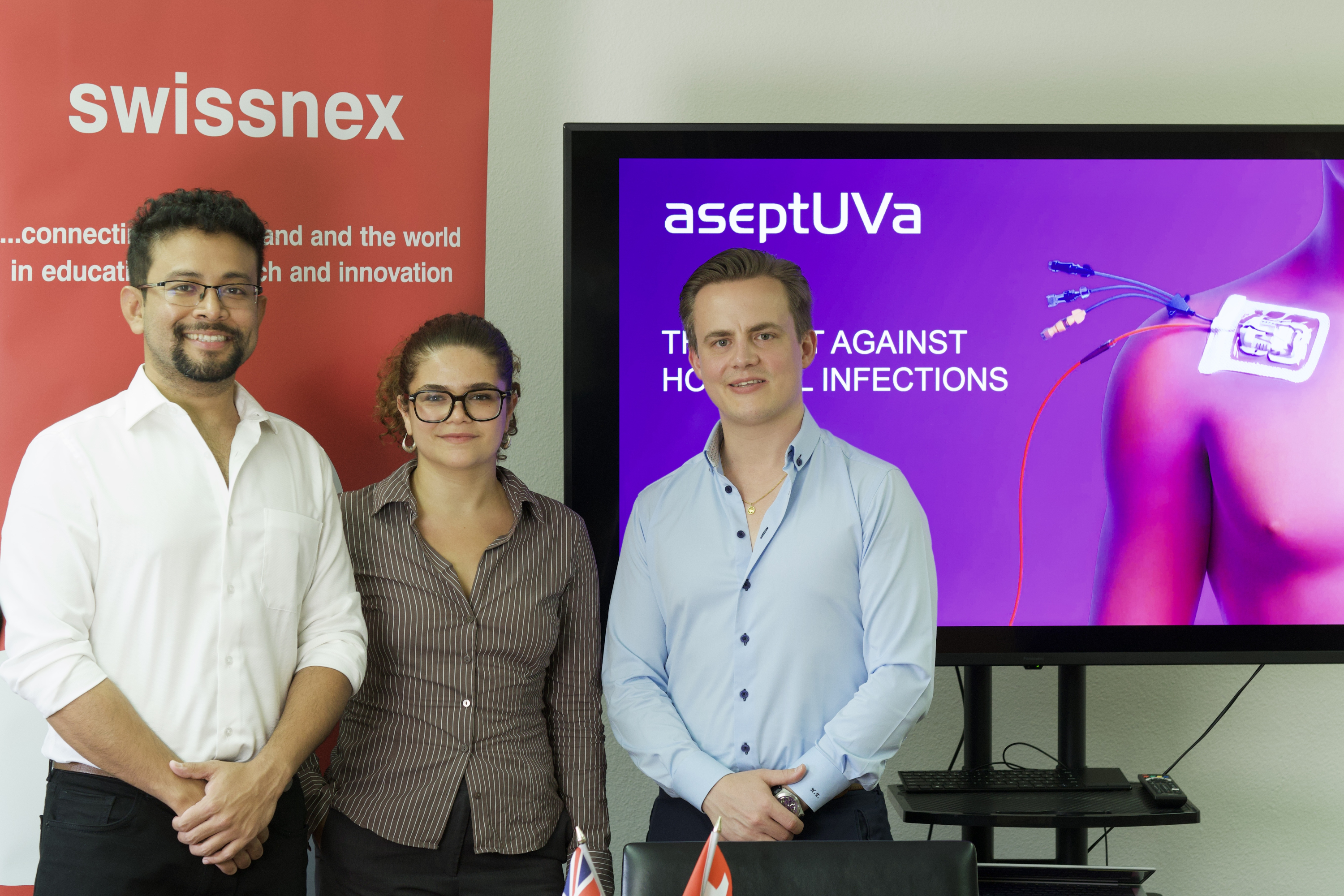
Aseptuva is a Swiss–UK medtech startup founded 2021, tackling one of healthcare's most persistent problems - hospital-acquired infections - with a Far-UVC disinfection technology for catheter sites. Since opening a UK base in Cambridge in 2022, the company has run preclinical and usability studies with UK hospitals and secured research grants across the UK healthcare system. Mathilde Reyes from the Embassy’s Swissnex team spoke with Henry Twerenbold, CEO & Co-Founder and Eashan Saikia, CTO & Co-Founder, about the science, the UK journey, and what's next.
1. Let’s start with the basics.What does Aseptuva actually do?
Henry Twerenbold (HT): We are developing a new approach to prevent hospital-acquired infections, particularly infections associated with catheters. Our technology uses Far-UVClight to combat microbial colonization of the catheter insertion sites automatically, locally and without manual intervention. The idea is simple: instead of treating an infection once it has occurred, we want to prevent it atone of its most common entry points. There is also a broader implication. Fewer infections lowers the need for antibiotics, which makes infection prevention an important part of addressing antimicrobial resistance. The WHO has identified antimicrobial resistance as one of the major global public health threats, with its impact expected to become increasingly significant in the coming decades.
2. Where did the idea come from?
Eashan Saikia (ES): The original motivation was very personal. I witnessed the consequences of hospital-acquired infections within my close environment. Afterwards, when the three founders met through the Innosuisse Business Concept course by Startup Campus, we validated the unmet need in Swiss and European hospitals through discussions with various doctors. Although we came from different backgrounds, we shared the view that there had to be a better way of addressing this problem, and conceptualized the first solution, which won us the first prize in the course.
And that was essentially the beginning of Aseptuva.
3. Aseptuva was first incorporated in Switzerland, but only a year later you opened your base in Cambridge. Why the UK?
HT: The NHS was a major reason. For a medtech company, having access to such a large healthcare system, combined with world-class expertise in microbiology, clinical research and medical devices, is extremely valuable. That led us to establish a base in Cambridge, which has the largest biomedical campus in Europe, alongside our Swiss activities in Bern and Zurich. It has already resulted in concrete collaborations, including research projects with UK hospitals and laboratories, two awarded “Invention for Innovation” projects from the National Institute for Health and Care Research. In addition, we got access to the national R&D centre “Catapult” funding through Innovate UK.
4. So is Aseptuva now more Swiss or more British?
HT: I think we have the best of both worlds. Aseptuva was founded in Switzerland, most of our team is based there, and organisations such as Innosuisse, the Sitem Medtech Hub in Bern and Technopark Zurich have played an important role in our development.
ES: And the UK has become a very natural extension of that. It gives us access to world-renowned researchers in institutions like Cambridge, Oxford, UCL, a huge consortium of NHS Trusts, diverse patient groups, and innovative biomedical startups with whom we are actively collaborating.
So we don't really see it as Switzerland versus the UK. The two ecosystems serve different purposes and complement each other extremely well. That’s also why, we pursue and apply for opportunities such as the bilateral Switzerland-UK Call by Innosuisse and Innovate UK to strengthen this cross-border innovation even more.
5. What role has Swissnex played inbuilding that bridge?
HT: Swissnex helped us enormously for a soft-landing for our UK journey. We participated in a Swiss-UK medtech mission as part of our Innosuisse Startup Camp that included the Association of British Healthtech Industries conference, an investor reception here at the Embassy, visits to NHS organisations and medtech companies, and sessions on conducting clinical trials in the UK. The important part wasn't simply attending events. It was meeting the right people.
Through Swissnex and the UK Department for Business, Innovation, Science and Technology, we also became more involved with the British-Swiss Chamber of Commerce (BSCC) and developed further relationships on both sides – including an invitation to the UK Embassy in Switzerland.
6. You talk about the advantages ofa British-Swiss approach. What has actually been difficult?
ES: Bureaucracy exists in both countries. One challenge for European medtech companies is the regulatory environment. Compared with the FDA pathway in the US, certain aspects of the European MDR framework can be slower and more complex.
HT: Switzerland has its own challenges as well. For example, employing highly qualified people from outside Europe has not always been straightforward for startups. Whereas in the UK, visa schemes like the Global Talent Visa, High-Potential Individual Visa supports in retaining the most innovative people from across the world. Organisations such as the Swiss Startup Association are doing important work to improve those conditions. And then there is perhaps the biggest challenge facing almost every scaling medtech company in Europe: access to sufficient growth capital, particularly when compared with the US.
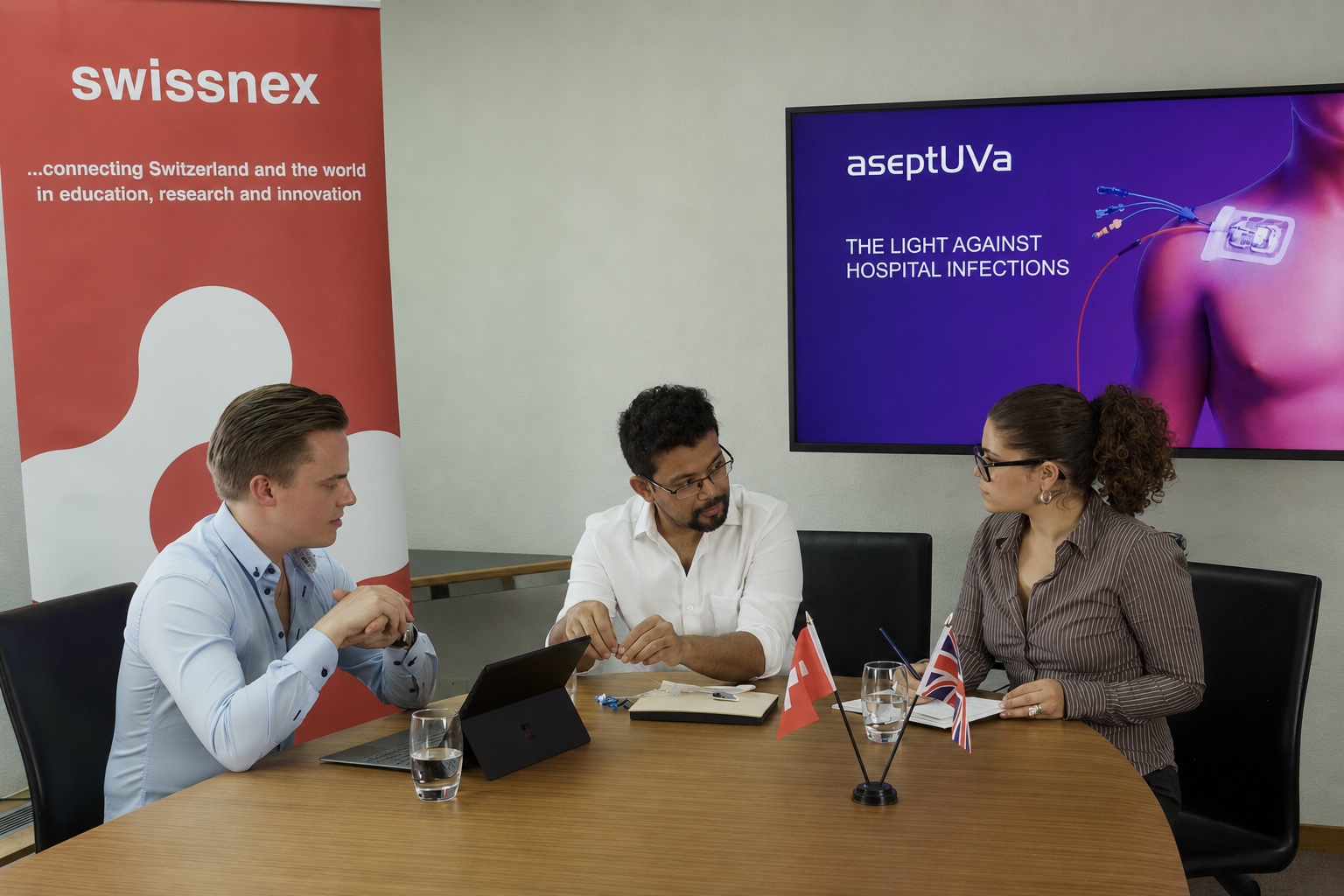
Left to right: Henry Twerenbold, EashanSaikia and Mathilde Reyes © FDFA
7. Speaking of capital - how are you funding your growth and expansion?
HT: We closed a CHF2.4 million Seed round last year, which allowed us to move from our early prototypes into much deeper R&D, IP, clinical preparation and regulatory work across Switzerland and the UK. We will require additional capital before market launch. That's why we are now preparing our Series A round of at least CHF 5 million. Importantly, our existing shareholders continue to financially support the company. We have already received follow-on investments from them for the Series A round.
8. What’s next on your journey?
ES: The major next step is our pilot clinical studies.
We have spent the past years building a strong preclinical evidence base in controlled environments. The next value-inflection point is demonstrating the technology is functional in clinical settings with patients. That is where the company moves from having a promising technology to building real world evidence toward regulatory approval.
9. Once you have regulatory approval, what is your ultimate ambition for Aseptuva?
HT:
The long-term objective is to establish a new approach to infection prevention-one that is automated, local and reduces the need for intervention after an infection has already occurred. Ultimately, we want to create a meaningful impact for both patients and healthcare systems: preventing thousands of avoidable deaths, reducing hospital stays, easing the burden on nursing staff and potentially saving billions in healthcare costs each year.
10. Finally, what advice would you give to other Swiss startups looking to expand into the UK?
ES: Don't underestimate the value of a warm introduction - particularly in the healthcare sector. It is an extremely relationship-driven ecosystem. Whether you're speaking to hospitals, clinicians, CROs or founders, trust and the right introductions matter.
We experienced that first-hand through the Swissnex team at the Swiss Embassy in London. The connections from our startup camp with the NHS and other UK healthcare stakeholders gave us a level of access that would have taken us much longer to build independently.
So my advice to other Swiss startups is simple: don't try to enter the UK ecosystem entirely on your own. Find the right bridge. For us, the Swissnex team in the UK has been exactly that.
